Tag: misinformation

  • Using AI to Generate Text

    ChatGPT and other AI tools are used all the time to generate text. The high school my fiance works at encourages teachers to utilize ChatGPT in lesson plans, yet students are constantly being forbidden from using AI text generation for assignments. As a student, I understand why. AI isn’t perfect and students need to be expressing what they’ve learned, which we cannot do if we upload an assignment to an AI program.

    I decided to try it myself. I prompted ChatGPT to create a blog post for me. I asked it to explain why Trump chose his cabinet picks for his second administration. I was curious as to what kind of reasoning it would provide for some of his more outlandish choices. However, I was extremely disappointed. 

    ChatGPT framed it’s response as to what it would assume Trump would pick if he were to be elected again, and the nominees were based on prior cabinet members. But unfortunately, Trump did win and his cabinet picks are worse than we could have imagined. I put ChatGPT’s response into a Google Doc so I could edit it. The introduction and conclusion were very general and didn’t need much fixing other than the tense of some words. However, the bulk of the post required a decent amount of fixing. Aside from changing names and removing the secondary assumptions, some of the picks did not carry the same qualifications as what ChatGPT had suggested. 

    ChatGPT's response to my prompt

    Using ChatGPT to generate a post made it painfully obvious that it was AI generated. It took more time and effort to correct the text than it would be to write my own, and less enjoyable. I would have much preferred to talk about the horrible picks such as Elon Musk, Dr. Oz, or Linda McMahon. 

    And let this serve as a reminder, to NEVER use AI to complete a school or professional assignment. ChatGPT was so incredibly wrong in it’s generated text that it would make it obviously false to anyone who read it. And even if you did decide to use and edit it, that is way too much work.I still may play around with AI and see what it can do, but my use will remain recreational. I have used ChatGPT in the past to summarize a text, but after this experiment I will not be doing that again.

  • Editing Wikipedia

    This week I worked on editing a Wikipedia page, which ended up being much more difficult than I had imagined, yet easier than I thought

    I would assume that most people are familiar with Wikipedia. It’s touted as an unreliable source, yet I always find it to be amongst the top when searching for something online. And typically, these pages can be quite insightful, with a massive amount of information. I know I frequently turn to Wikipedia because it’s provides a comprehensive explanation about a topic. I’m more likely to look at a Wikipedia page to get a general understanding before doing some more research to get further detail.

    When thinking about what page I’d like to edit, I had some difficulty but came up with some good ideas, or so I thought. My original idea was to add someone to my hometown’s notable people list. I went to highschool with Kariselle Snow, an influencer who has been on dating shows such as MTV’s Are You The One and Netflix’s Sexy Beast and Perfect Match. Additionally, she participated in the Miss America pageants and was a cheerleader for the Baltimore Ravens. However, it was difficult to find sources that weren’t online gossip mills about the shows. I was forced to look elsewhere. Rachel Harrison, who wrote books such as Cackle and Such Sharp Teeth went to highschool with my fiance. However, I was unable to find substantial proof that she actually went to school there. Unfortunately, I can’t cite personal yearbooks on Wikipedia.

    I decided I need to think a bit smaller and broader. Finally, with some inspiration from my fiance, I stumbled upon a Wikipedia page that hosted a list of skateparks throughout the world. I finally found something I could add! Skateparks in the United States were categorized by state, and none were listed for my home state of New Jersey. Perfect!

    Screenshot of Wikipedia's list of skateparks without New Jersey

    I searched through NJGrind and GoSkate for a list of skateparks based on my location. There was a lot… Too many for me to feel comfortable with adding to this Wikipedia page. I enlisted my fiance’s assistance once again, as he is someone who regularly visits various skateparks around the state.

    So, instead of adding 20+ different parks to Wikipedia, I added some that were important to the community. Or at least according to him. Once I finally knew what I wanted to add it was pretty easy. Using the visual editor I could clearly see what I was doing. I was just typing onto the page, adding hyperlinks and citations was really easy. And I had little difficulty finding sources, as most of these parks were recently renovated and featured in papers. And ones that I could not find sources for had pages dedicated to them through their municipality.

    Now, Wikipedia has five parks listed on their list of skateparks in New Jersey!

    Highlighting my additions to Wikipedia's list of skateparks.

    Overall, editing a Wikipedia page was not as difficult as I ever though it would be. My experience in the processes makes me for confident in trusting the information provided on various pages. And although I will never use it to cite in an academic paper, I think it’s a great place to get a quick and comprehensive overview of a topic before diving into it. And next time I notice something missing from a Wikipedia page I won’t be afraid to add it in!

  • Media Literacy and Unions

    I take a lot of pride in being able to go back to school at ASU, and I’m very thankful that my job at Starbucks provides me with this opportunity. My studies at ASU have made me more mindful of the media I consume and have taught me how to do better research.

    However, I do not just work at Starbucks. My store recently unionized, and I was lucky enough to be selected as its union representative. This week, I will be involved in my first bargaining session as a delegate! It’s been a challenge adding this new workload on top of already working and going to school full-time, but I’m very excited to work with all the other delegates and fight for my partners! 

    In the process of unionizing, I noticed a lot of misinformation about unions from my partners and people who don’t even work at Starbucks. Unions play an essential role in the workplace. Aspects of media literacy also pertain to our daily lives. It’s important to be able to identify misinformation in the media and spread by word of mouth. Either way, misinformation should be faced with proper research. 

    Misinformation about unions is incredibly dangerous. Workers have the right to choose whether to unionize or not, and feeding them with misinformation can deprive them of the benefits they would gain. I have coworkers who are afraid they’re not going to get paid, either from union dues or because they think Starbucks would outright withhold their paycheck. 

    Media literacy is an important skill. Witnessing a workplace unionize has shown me how being media illiterate affects people in their daily lives.

    Misinformation

    When Starbucks stores first began to unionize, Starbucks committed numerous NLRA violations. These actions resulted in employees being fired, disciplined, and even withholding pay. With the help of the media, these violations became wild accusations on social media. I heard partners tell me that they didn’t want to unionize because we would stop getting paid. And although this is technically true, it’s been blown out of proportion. This misinformation is harmful to workers. I hear my coworkers complain constantly about our working conditions and pay. It upsets me to know that they are falling victim to misinformation that is deterring them from the union when it will fight for them and their wants and needs. We need to put an end to the spread of misinformation. If you read something online or a friend tells you something and you think, “Wow! That’s crazy!” take a second and do a simple search to double-check if that information is true.

    Research

    Unionizing takes work. Union busting is a challenge that all organizing workers face, regardless of their employer; this is not something that is unique to working at Starbucks. But the question stands: how do you organize workers without being blatantly obvious and putting your job in danger? How do you communicate effectively to a large group without it becoming workplace gossip? It’s hard to find information about what the union will do for workers, especially with Starbucks Workers United. Since this union is new and there hasn’t been a contract, there is little information online. No facts are being shared; they are simply goals they want to achieve. People lack media literacy skills concerning research. Even outside the union, we’ve all been asked questions that could have easily been googled. But it’s important to have this skill. People don’t do their own research to see if a union is something they want but then proceed to ask someone who feeds them with misinformation. It’s a dangerous cycle, both online and in person, and at or outside work.

    Media literacy is an important asset that can impact our daily lives. Being able to identify misinformation or to do proper research can negatively affect us, as I’ve shown with unions. In today’s world, it’s important that we have a voice and fight for our rights, and learning how to be media literate is the first step!

    Disclaimer: I am not speaking on behalf of SBWU nor am I promoting unions.

  • Antisemitism in the media

    I am a Jewish-American woman. I’ve encountered antisemitism many times growing up, ranging from hurtful speech to acts of violence. As the world progresses, we’ve seen a rise in attempts to put antisemitism to rest. However, social media creates a perfect platform for folks to spew antisemitic rhetoric that invalidates an entire religion. When celebrities and politicians participate in this behavior, it fuels others to follow in their directions, worsening the situation.

    Something I’ve noticed in recent years with the popularity of online DNA tests such as 23andMe is people identifying as Jewish because they’ve received results with Ashkenazi Jewish ancestry. Although this testing is important due to the serious health issues related to Ashkenazi DNA, a person’s religion is not identifiable through DNA testing. Judaism is a closed practice, meaning that not anyone can go to temple or participate in holidays and claim to be Jewish. Although there are different opinions on defining what makes a person Jewish, claiming to be genetically Jewish while actively participating in another religion invalidates the Jewish people.

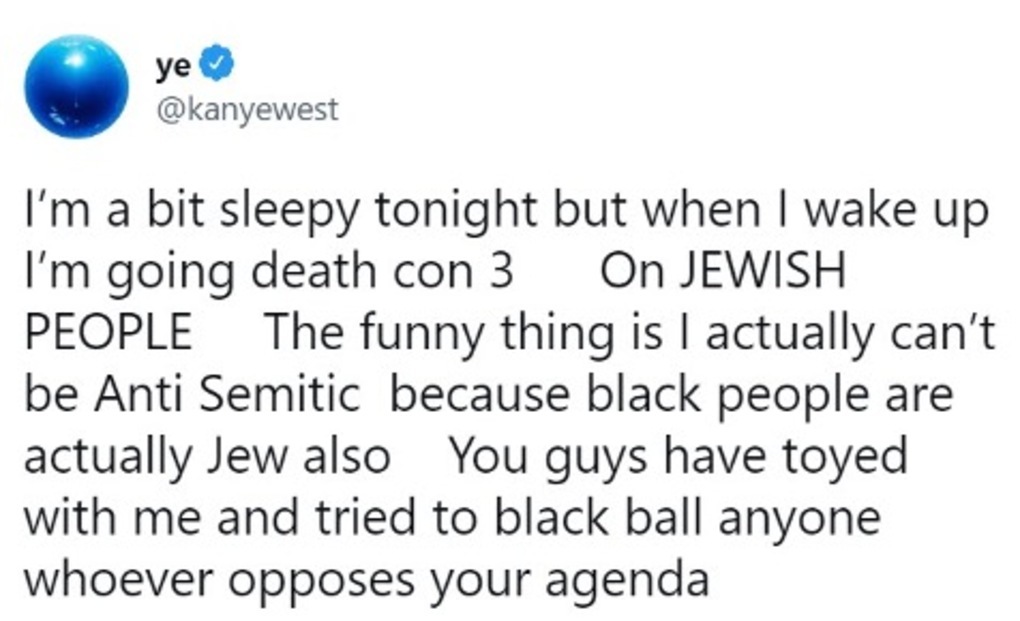
    However, the idea of identifying as Jewish is not just pinpointed to DNA tests; rapper Kanye West claims that his identity as a black man constitutes him as being Jewish. He uses these claims to justify his antisemitic remarks that perpetuate stereotypes, endorse conspiracy theories, and call for violence against Jews. Kanye has a large number of supporters who read and believe what he says online, which fuels antisemitism. If a non-Jewish person believes that Kanye is justified in his remarks, they may feel justified in other antisemitic actions or speech.

    Tweet by Kanye West: "I'm a bit sleepy tonight but when I wake up I'm going death con 3 on Jewish people. The funny thing is I actually can't be antisemitic because black people are actually Jew also. You guys have toyed with me and tried to black ball anyone whoever opposes your agenda."

    Judaism is practiced worldwide, and it doesn’t discriminate against a person’s skin color. However, this claim, along with his hate speech, invalidates those of us who actively practice the religion. As a white woman, I don’t want to invalidate Kanye’s identity as a black man. However, I can’t excuse him using his identity to invalidate my own as a Jewish woman.

    Invalidating a religion doesn’t stop with false self-identification. There has been a theme with people who disagree with government policies and relate them to the Holocaust. Although these people may feel unjustly treated for not agreeing or abiding by these policies, they do not compare to the mass extermination of a group of people.

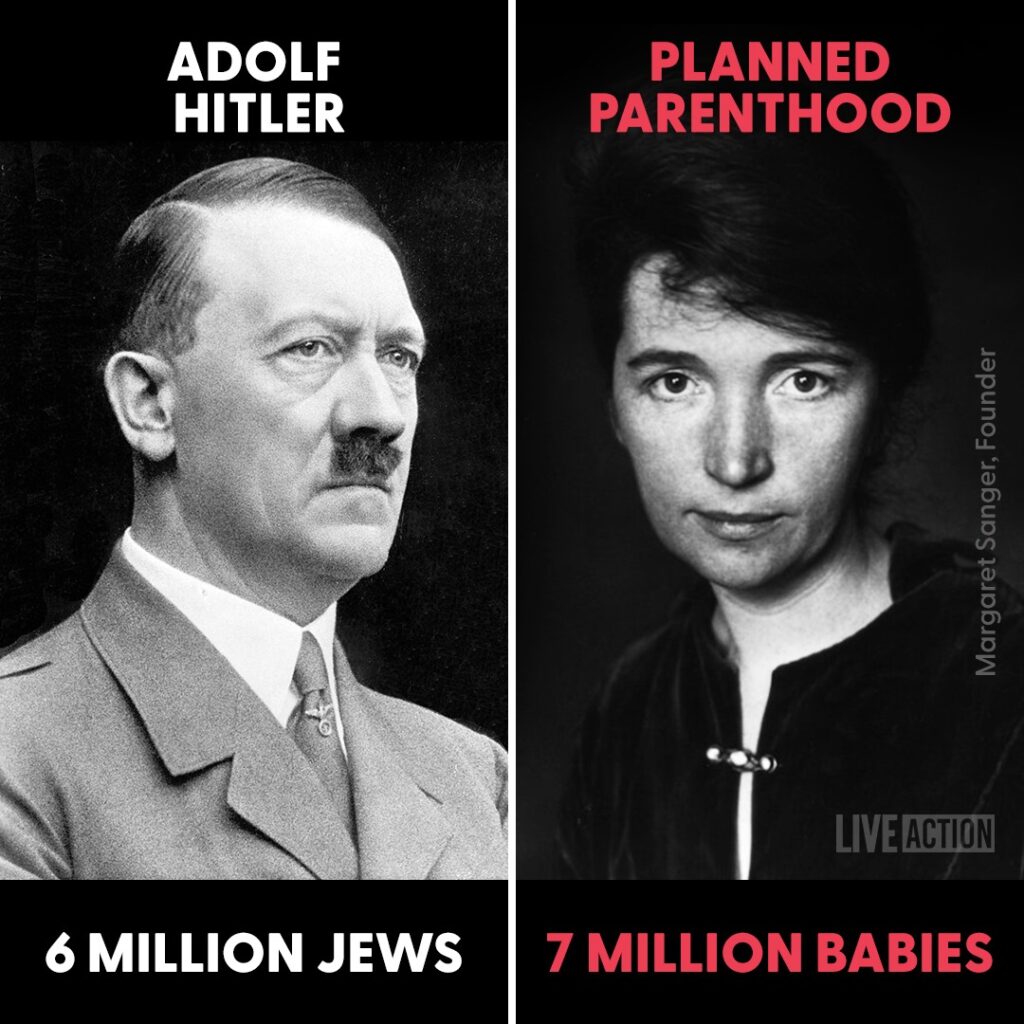
    The topic of abortions has always been, and will always be, controversial; however, with the overturn of Roe v. Wade, people took to social media to defend their stance at any opportunity they could, including relating abortion to the Holocaust. Politicians such as Rep. Mike Johnson, Sen. Darren Bailey, Sen. Ben Albritton, and Rep. Terri Collins have all publicly made this comparison. Pro-life groups online share instigating posts of the same nature; Live Action shared a photo comparing Hitler to Margaret Sanger (founder of Planned Parenthood), comparing the deaths of the Holocaust with abortions. These kinds of posts spread like wildfire on social media; they not only dismiss the tragedies that occurred during the Holocaust but any other act of genocide in history.

    Photo of Adolph Hitler, with additional text saying "6 million Jews" next to a photo of Margaret Sanger saying "7 million babies"

    The difficulty with this is that people who identify as pro-life believe that abortion is equivalent to murder. This is why many laws were placed in effect to convict people associating, performing, and receiving abortions. Although I disagree, I understand why they believe what they do. Despite using the tragedies of the Holocaust to fuel their narrative, there is also an issue of the pro-life stance along with Judaism. Jewish law believes that life begins at first breath, and with this, abortion is considered health care and is encouraged if it endangers the mother’s health physically or mentally. Therefore, the comparison between the Holocaust and abortions not only bastardizes the genocide of Jewish people but uses it to push Catholic beliefs on Jewish people.

  • Book Bans

    Book bans are a way to censor information that doesn’t fit into a certain narrative or rhetoric. According to National Geographic, the earliest book bans in the United States took place in 1650, when the Massachusetts Bay colonist William Pynchon published a religious pamphlet that differed from the religious norms at the time. Other colonists denounced his writing as heresy and burned them. Later on in the US there were bans on literature that was anti-slavery or anything that was deemed “immoral.”

    Today, we see the controversy surrounding reading material in schools and public libraries. The American Library Association noted the top three reasons for book censorship is due to literature containing “sexually explicit” content, “offensive language,” and/or the content is “unsuited for any age group.” Although a CBS poll shows that most Americans reject book bans, PEN America says that most bans are done through smaller organized political groups such as Moms for Liberty.

    Most books that are being targeted are written or about minority experiences. According to PEN America’s Index of School Book Ban List, 41% address LGBTQIA+ themes, 40% contain POC protagonists or prominent secondary characters, 22% contain sexual content (ranging from puberty to sexual abuse), and 9% are nonfictional books (biographies, autobiographies, and memoirs)

    There is no standard for what is deemed inappropriate for readers, and the rhetoric used to push bans causes hysteria within a community. For instance, in Marion County, Mississippi, the graphic novel series Heartstopper by Alice Oseman was being challenged. The books contain a wholesome romance story between two teenage boys, yet they’re being described as “pornography” and that homosexuality is a sin according to the Bible. This rhetoric not only villainizes literature, but also the authors and characters of these books.

    The issue of book banning is still an ongoing problem, and with the pressure of the upcoming election and the threat of Project 2025, this issue is nowhere near being settled. Unfortunately, there will always be people who are trying to censor certain demographics and narratives. However, many libraries and bookstores celebrate Banned Book Week (September 22-28, 2024) in order to raise awareness and encourage reads to read titles they may have otherwise not considered.