Tag: media

  • Addressing the Claims by the IMLS: Fact Checking our Resources

    It’s important to stop and think about the media we consume. Who’s sharing this information? What was their intention? How are you reacting to it?

    The Institute of Museum and Library Services, or IMLS, is a federal program that provides funding to, you guessed it, museums and libraries! On April 3, they posted a series of images onto Instagram explaining what taxpayer money is funding at the IMLS. Here’s what they had to say:

    $105,000 to address “systemic racism” in museums,

    $400,000 to research LGBTQ+ library users’ metadata,

    $1,500,000 for social justice programming,

    $6,700,000 to enhance equitable library programs,

    $4,000,000 for diverse staff development,

    $700,000 to research post-pandemic DEI practices,

    $140,000 to strengthen librarians’ understanding of LGBTQIA+ health, and

    $250,000 to erect LGBTQIA+ historical markers across Ohio.

    In total, that’s $13,795,000 worth of taxes that are being used to fund the IMLS. It’s a seemingly strange post. American citizens have the ability to look at what taxpayer money is funding, so this information isn’t groundbreaking. But we don’t see our towns posting on Facebook that they spent however much fixing potholes last year. So we ask, why are we given this information?

    Well, doing something as simple as googling “imls” shows us that somethings up. Funding has been pulled, people are losing their jobs, and states are threatening to sue… One thing all of these articles have in common is one thing: the IMLS is being targeted.

    On March 14, President Donald Trump signed an executive order that the IMLS along with many other government agencies that have been deemed “unnecessary” are to be “eliminated to the maximum extent.”

    But this is the IMLS Instagram page! Why would they brag about funding being pulled? Is it real? Did they get hacked? Who is sharing this information?

    Well, it’s complicated because all IMLS employees were put on administrative leave. So, we’re left to assume that it was the acting director, Keith Sonderling, the last remaining “employee.”

    But what about the content? What does $6.7 million to enhance equitable library programs mean? What does this do? It’s a lot of money! Is this really where taxpayer dollars are going?

    Well, this information is available to us on the IMLS government website. Under their additional resources tab, anyone can pull up the Fiscal Year 2025 Congressional Justification, a 48-page pdf detailing how much funding they’re looking for and how they plan on spending it. It may not be an exciting read, but it’s fairly easy to go through and notice that nothing in that post is representative of what is being said in the most recent Congressional Justification.

    So, what about the post is true? Well, the IMLS does provide grants specifically for African Americans, American Latinos, Native Americans, and Native Hawaiians. They also are actively providing equitable services across the country such as learning materials and internet access. They fund research into library user’s metadata, to better fill the needs of their patrons. And like many other professions, they ask their employees to continue their education.

    According to their annual public library survey, there are over 9,000 libraries that receive funding from the IMLS. $6.7 million to “enhance equitable library programs” across 9,000 libraries comes out to $744 per library, a seemingly insignificant amount.

    It’s important that we check where we get our information from. We need to stop and think about what the intent of the information was, who is sharing it, and whether or not I can be trusted. Through fact-checking a government post, we can see that were being told misinformation—a piece of propaganda against your local library. Although there may be truth behind the original post, it manipulates the reader into believing that one thing means something else.
  • Antisemitism in the media

    I am a Jewish-American woman. I’ve encountered antisemitism many times growing up, ranging from hurtful speech to acts of violence. As the world progresses, we’ve seen a rise in attempts to put antisemitism to rest. However, social media creates a perfect platform for folks to spew antisemitic rhetoric that invalidates an entire religion. When celebrities and politicians participate in this behavior, it fuels others to follow in their directions, worsening the situation.

    Something I’ve noticed in recent years with the popularity of online DNA tests such as 23andMe is people identifying as Jewish because they’ve received results with Ashkenazi Jewish ancestry. Although this testing is important due to the serious health issues related to Ashkenazi DNA, a person’s religion is not identifiable through DNA testing. Judaism is a closed practice, meaning that not anyone can go to temple or participate in holidays and claim to be Jewish. Although there are different opinions on defining what makes a person Jewish, claiming to be genetically Jewish while actively participating in another religion invalidates the Jewish people.

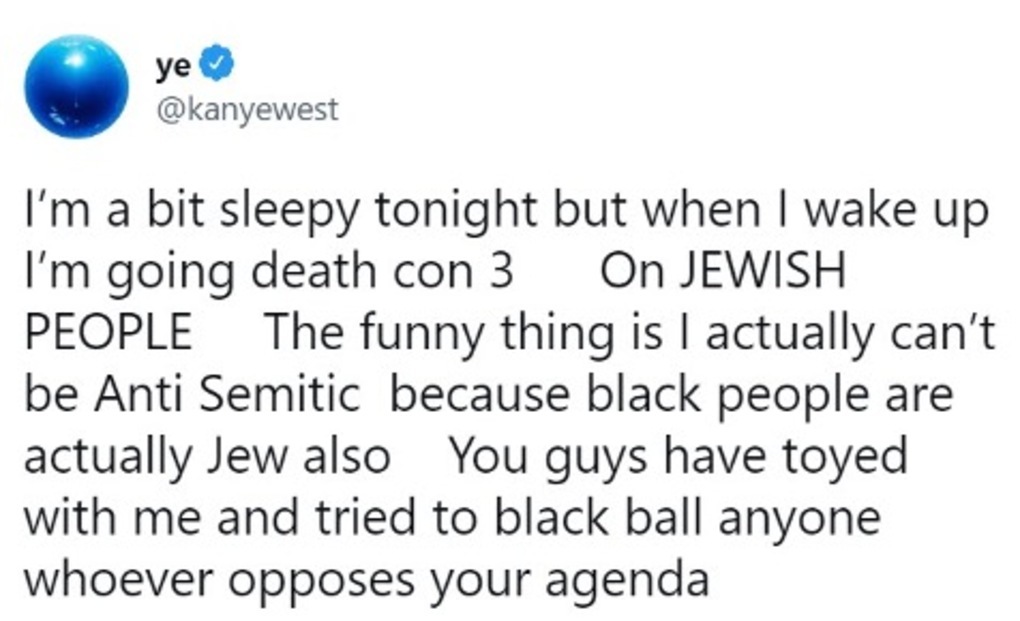
    However, the idea of identifying as Jewish is not just pinpointed to DNA tests; rapper Kanye West claims that his identity as a black man constitutes him as being Jewish. He uses these claims to justify his antisemitic remarks that perpetuate stereotypes, endorse conspiracy theories, and call for violence against Jews. Kanye has a large number of supporters who read and believe what he says online, which fuels antisemitism. If a non-Jewish person believes that Kanye is justified in his remarks, they may feel justified in other antisemitic actions or speech.

    Tweet by Kanye West: "I'm a bit sleepy tonight but when I wake up I'm going death con 3 on Jewish people. The funny thing is I actually can't be antisemitic because black people are actually Jew also. You guys have toyed with me and tried to black ball anyone whoever opposes your agenda."

    Judaism is practiced worldwide, and it doesn’t discriminate against a person’s skin color. However, this claim, along with his hate speech, invalidates those of us who actively practice the religion. As a white woman, I don’t want to invalidate Kanye’s identity as a black man. However, I can’t excuse him using his identity to invalidate my own as a Jewish woman.

    Invalidating a religion doesn’t stop with false self-identification. There has been a theme with people who disagree with government policies and relate them to the Holocaust. Although these people may feel unjustly treated for not agreeing or abiding by these policies, they do not compare to the mass extermination of a group of people.

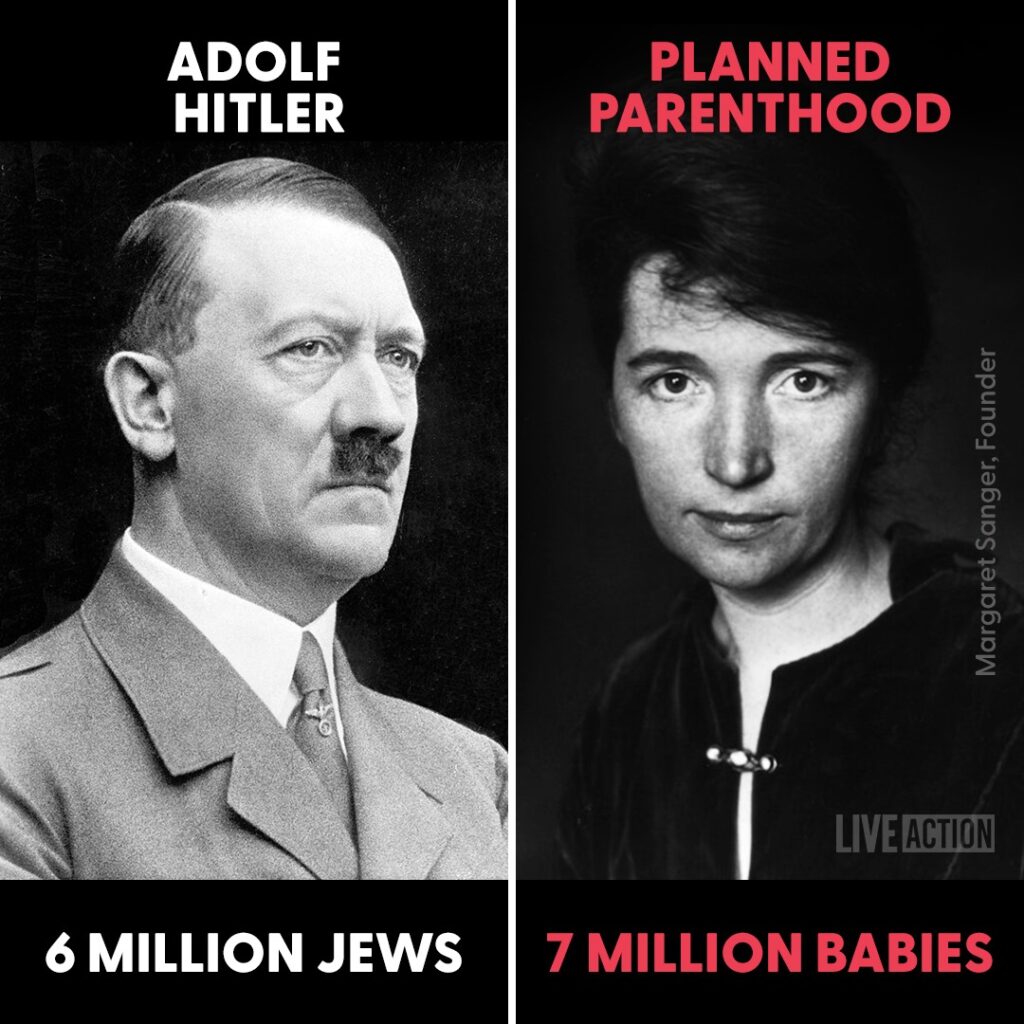
    The topic of abortions has always been, and will always be, controversial; however, with the overturn of Roe v. Wade, people took to social media to defend their stance at any opportunity they could, including relating abortion to the Holocaust. Politicians such as Rep. Mike Johnson, Sen. Darren Bailey, Sen. Ben Albritton, and Rep. Terri Collins have all publicly made this comparison. Pro-life groups online share instigating posts of the same nature; Live Action shared a photo comparing Hitler to Margaret Sanger (founder of Planned Parenthood), comparing the deaths of the Holocaust with abortions. These kinds of posts spread like wildfire on social media; they not only dismiss the tragedies that occurred during the Holocaust but any other act of genocide in history.

    Photo of Adolph Hitler, with additional text saying "6 million Jews" next to a photo of Margaret Sanger saying "7 million babies"

    The difficulty with this is that people who identify as pro-life believe that abortion is equivalent to murder. This is why many laws were placed in effect to convict people associating, performing, and receiving abortions. Although I disagree, I understand why they believe what they do. Despite using the tragedies of the Holocaust to fuel their narrative, there is also an issue of the pro-life stance along with Judaism. Jewish law believes that life begins at first breath, and with this, abortion is considered health care and is encouraged if it endangers the mother’s health physically or mentally. Therefore, the comparison between the Holocaust and abortions not only bastardizes the genocide of Jewish people but uses it to push Catholic beliefs on Jewish people.

  • Book Bans

    Book bans are a way to censor information that doesn’t fit into a certain narrative or rhetoric. According to National Geographic, the earliest book bans in the United States took place in 1650, when the Massachusetts Bay colonist William Pynchon published a religious pamphlet that differed from the religious norms at the time. Other colonists denounced his writing as heresy and burned them. Later on in the US there were bans on literature that was anti-slavery or anything that was deemed “immoral.”

    Today, we see the controversy surrounding reading material in schools and public libraries. The American Library Association noted the top three reasons for book censorship is due to literature containing “sexually explicit” content, “offensive language,” and/or the content is “unsuited for any age group.” Although a CBS poll shows that most Americans reject book bans, PEN America says that most bans are done through smaller organized political groups such as Moms for Liberty.

    Most books that are being targeted are written or about minority experiences. According to PEN America’s Index of School Book Ban List, 41% address LGBTQIA+ themes, 40% contain POC protagonists or prominent secondary characters, 22% contain sexual content (ranging from puberty to sexual abuse), and 9% are nonfictional books (biographies, autobiographies, and memoirs)

    There is no standard for what is deemed inappropriate for readers, and the rhetoric used to push bans causes hysteria within a community. For instance, in Marion County, Mississippi, the graphic novel series Heartstopper by Alice Oseman was being challenged. The books contain a wholesome romance story between two teenage boys, yet they’re being described as “pornography” and that homosexuality is a sin according to the Bible. This rhetoric not only villainizes literature, but also the authors and characters of these books.

    The issue of book banning is still an ongoing problem, and with the pressure of the upcoming election and the threat of Project 2025, this issue is nowhere near being settled. Unfortunately, there will always be people who are trying to censor certain demographics and narratives. However, many libraries and bookstores celebrate Banned Book Week (September 22-28, 2024) in order to raise awareness and encourage reads to read titles they may have otherwise not considered.