Category: Misinformation and Society

Blog posts made for Misinformation and Society

  • Misinformation Creation Activity – Logical Fallacies

    Misinformation spreads fast, and it’s hard to keep up with and correct it whenever we come across. And while we can’t stop the spread of misinformation, we can do our part in educate others in being able to spot any misinformation they come across.

    I wanted to use what I’ve learned and see how I could put it to work in my future. I’m not sure how often I said it on here before, but my goal when I’m done at ASU is to get my master’s to become a librarian. Ideally, I would like to be a children’s or young adult librarian.

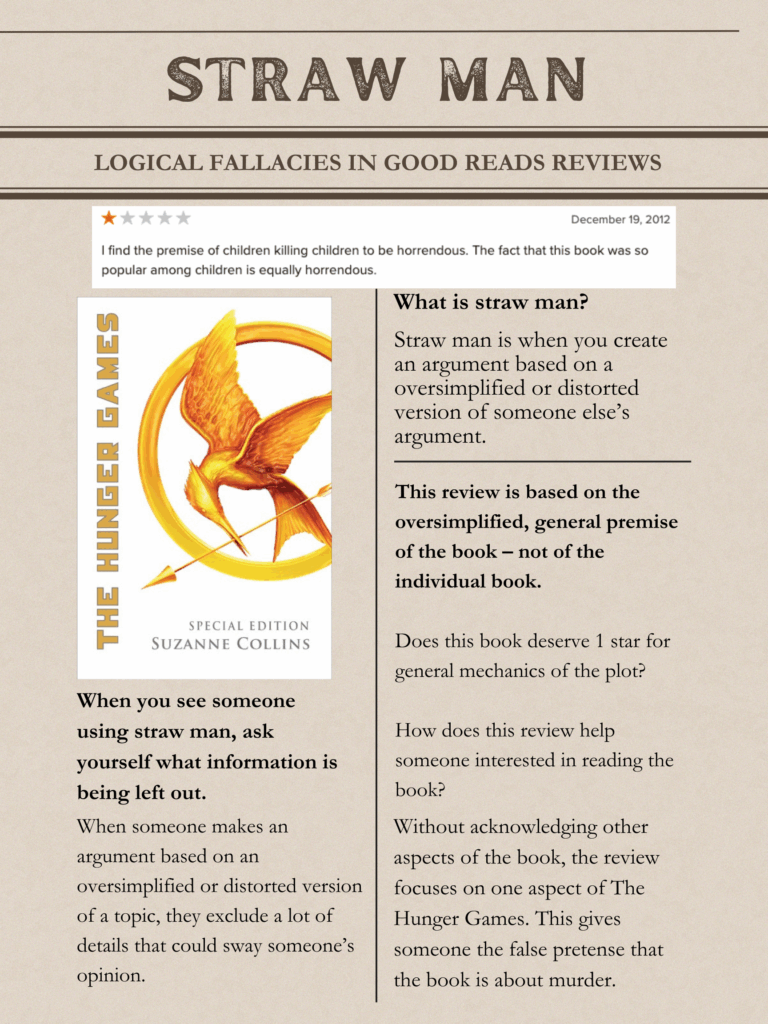
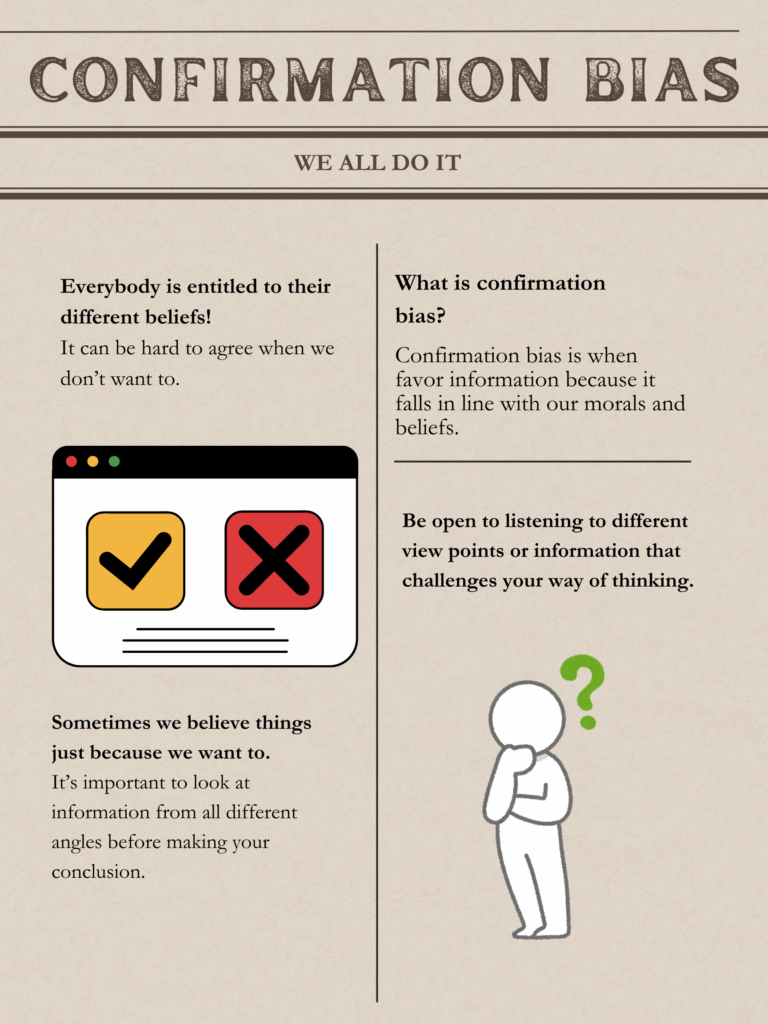
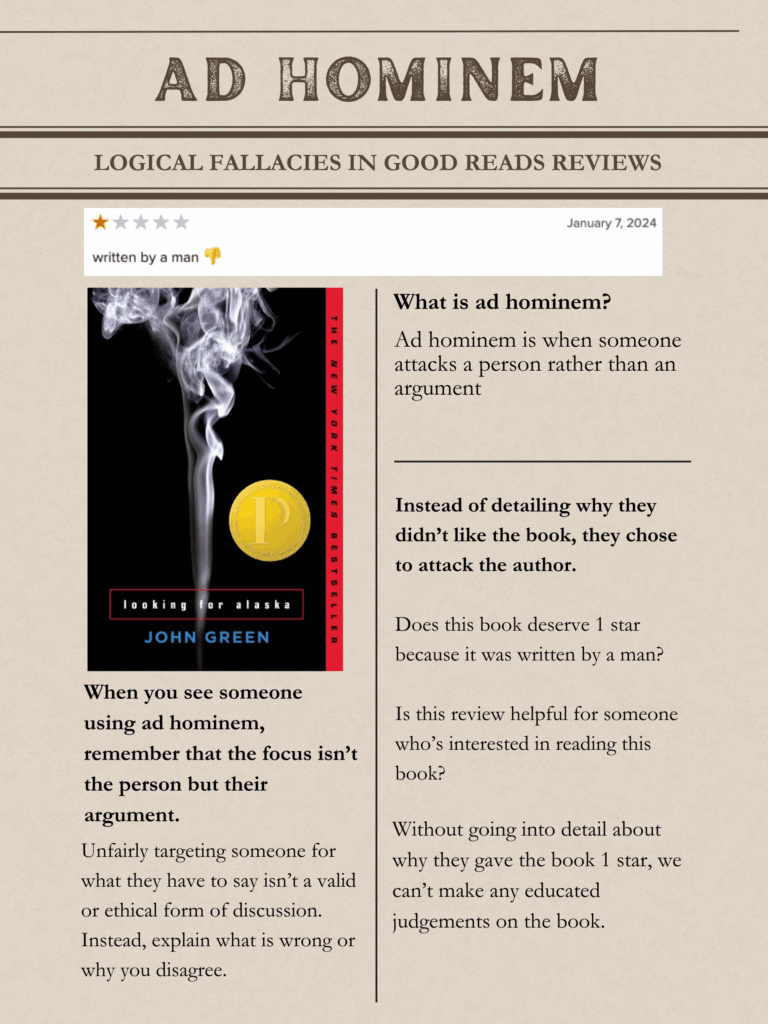
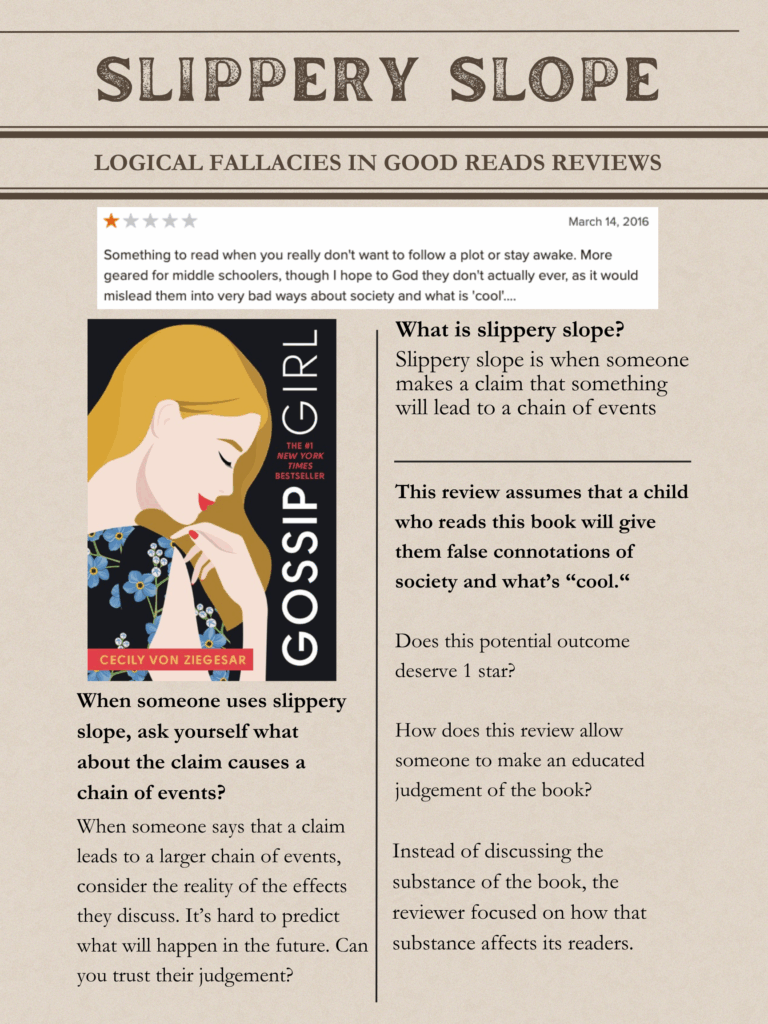
    Therefore, my goal was to create a display for a young adult library that would educate them in noticing misinformation. I created four graphics that would be put together to make one large display/bulletin board. My focus was to educate them on logical fallacies and confirmation bias. Since my target audience is teenagers in a library, I still wanted it to be fun and unpolitical. Being that the intended audience would be in either a public or school library, that would mean I’m in the position of working for a local government or school. My goal was to teach them about logical fallacies being used in everyday use so they can put it to work when they encounter misinformation in the wild.

    The way I chose to address logical fallacies was through book reviews submitted by users on Good Reads. I focused on popular books that would be known by teenagers, and used one star reviews because they can be silly. There are questions to prompt discussions.

    My end goal was to have teenagers see these one star reviews and understand why their logical fallacies. I chose books where the stories may be well known by the teenagers. I want them to read the review, understand why it’s a logical fallacy and discuss with others. The goal is to have them think “I read that book and the review isn’t fair.” Or, if they haven’t read it, they may be more interested in finding out for themselves, which would be a way to fact-check the reviews. By giving them these tools, in this environment, it allows them to practice these skills in a safe environment, preparing them for misinformation they come across in the future.
  • Trusting Our Online Communities

    The internet is full of misinformation, and as participants, we should learn to fact-check what we see online. However, it can be difficult when anyone can post anything online. How are we supposed to know if something is trustworthy or not? Do we have to fact-check all claims that we come across?

    Who should be responsible for dealing with misinformation? The platform or its users? Ideally, social media platforms would simply not post or take down misinformation. Unfortunately, that’s not always the case, which is why we need to understand how misinformation works and how to spot it.

    That’s why it’s essential to know how different sites attempt to limit the spread of misinformation. By understanding how social media platforms combat misinformation, we, as users, can better identify any misinformation we may encounter. I decided to look into two very different sites: Facebook and Reddit.

    In 2016, Facebook introduced fact-checking to posts and partnered with five fact-checking organizations to “improve the quality of online media.” Facebook hired real people to go through identified articles individually, fact-check them, and explain why they are being flagged. However, the system wasn’t perfect; they didn’t address memes and paid content or see conspiracy theories or right-wing media sources. Yet this past January, Meta decided to end the program. In a video posted by Mark Zuckerberg, they ended the program because it was a complex system with many mistakes. On PBS News Hour, they identified the change in policy to be politically motivated, Zuckerburg noting the recent election in the announcement; even the President believes that it is caused by his “threats.”

    Putting this knowledge to work when using Facebook or any other Meta social media site is essential. There is nothing left to prevent the spread of misinformation except for the users, who now must trust thy neighbor. How much do you trust someone’s ability not to share false information? Their ability to fact-check? Their ability to identify misinformation? People are naturally biased, which makes them more likely to spread misinformation that aligns with their community, interests, and beliefs. Even if it’s shared by someone you trust and has all of the best intentions, you should always be on the lookout for misinformation.

    Very similarly, yet entirely different, is Reddit. The company does not provide fact-checking on claims and articles posted online. However, Reddit is home to a unique phenomenon where users actively fight against misinformation. Subreddits, or online communities, are known to collectively identify false information. Reddit employs a reputation score called karma that helps users identify whether or not someone may be reliable or trustworthy. Moderators volunteer their free time to make these online communities safe spaces for people to enjoy and connect. Furthermore, each subreddit is unique, with different members, ideals, and community guidelines that have a role in the spread of misinformation. A 2024 study showed that even communities such as r/conspiracy and r/skeptic take pride in not sharing misinformation, although it may not be on the same level as r/science. However, the level of community moderation reduces in quality as the theme of a subreddit becomes more vague, such as r/bestof or r/TooAfraidTooAsk.

    It’s interesting to look at how these two sites wrestle with misinformation. Although neither company removes or identifies false claims, the way users interact on the sites makes one more reliable than the other. However, everyone who uses the internet should always be careful of what claims they see online. Being able to trust your community does not mean you won’t come into contact with misinformation online, whether it’s intentional or not.

  • Addressing the Claims by the IMLS: Fact Checking our Resources

    It’s important to stop and think about the media we consume. Who’s sharing this information? What was their intention? How are you reacting to it?

    The Institute of Museum and Library Services, or IMLS, is a federal program that provides funding to, you guessed it, museums and libraries! On April 3, they posted a series of images onto Instagram explaining what taxpayer money is funding at the IMLS. Here’s what they had to say:

    $105,000 to address “systemic racism” in museums,

    $400,000 to research LGBTQ+ library users’ metadata,

    $1,500,000 for social justice programming,

    $6,700,000 to enhance equitable library programs,

    $4,000,000 for diverse staff development,

    $700,000 to research post-pandemic DEI practices,

    $140,000 to strengthen librarians’ understanding of LGBTQIA+ health, and

    $250,000 to erect LGBTQIA+ historical markers across Ohio.

    In total, that’s $13,795,000 worth of taxes that are being used to fund the IMLS. It’s a seemingly strange post. American citizens have the ability to look at what taxpayer money is funding, so this information isn’t groundbreaking. But we don’t see our towns posting on Facebook that they spent however much fixing potholes last year. So we ask, why are we given this information?

    Well, doing something as simple as googling “imls” shows us that somethings up. Funding has been pulled, people are losing their jobs, and states are threatening to sue… One thing all of these articles have in common is one thing: the IMLS is being targeted.

    On March 14, President Donald Trump signed an executive order that the IMLS along with many other government agencies that have been deemed “unnecessary” are to be “eliminated to the maximum extent.”

    But this is the IMLS Instagram page! Why would they brag about funding being pulled? Is it real? Did they get hacked? Who is sharing this information?

    Well, it’s complicated because all IMLS employees were put on administrative leave. So, we’re left to assume that it was the acting director, Keith Sonderling, the last remaining “employee.”

    But what about the content? What does $6.7 million to enhance equitable library programs mean? What does this do? It’s a lot of money! Is this really where taxpayer dollars are going?

    Well, this information is available to us on the IMLS government website. Under their additional resources tab, anyone can pull up the Fiscal Year 2025 Congressional Justification, a 48-page pdf detailing how much funding they’re looking for and how they plan on spending it. It may not be an exciting read, but it’s fairly easy to go through and notice that nothing in that post is representative of what is being said in the most recent Congressional Justification.

    So, what about the post is true? Well, the IMLS does provide grants specifically for African Americans, American Latinos, Native Americans, and Native Hawaiians. They also are actively providing equitable services across the country such as learning materials and internet access. They fund research into library user’s metadata, to better fill the needs of their patrons. And like many other professions, they ask their employees to continue their education.

    According to their annual public library survey, there are over 9,000 libraries that receive funding from the IMLS. $6.7 million to “enhance equitable library programs” across 9,000 libraries comes out to $744 per library, a seemingly insignificant amount.

    It’s important that we check where we get our information from. We need to stop and think about what the intent of the information was, who is sharing it, and whether or not I can be trusted. Through fact-checking a government post, we can see that were being told misinformation—a piece of propaganda against your local library. Although there may be truth behind the original post, it manipulates the reader into believing that one thing means something else.

  • Fake It to Make It: Understanding the Spread of Misinformation

    News Literacy Project’s RumorGuard is a great tool to learn how to identify misinformation on social media. The site shows example social media posts and breaks down different aspects of the post that the user can identify as being falsified information. News Literacy Project identifies five key aspects to be aware of to protect yourself from misinformation: authenticity, source, evidence, context, and reasoning. They also go through different topics and themes of misinformation such as copypasta, doctored photos, and confirmation bias.

    News Literacy Project provides a lot of great tools and information for someone to protect themselves against misinformation. But sometimes, we learn best by doing things for ourselves. I tried my hand at the game Fake It to Make It, a simulation game where you create your own fake news company to spread misinformation! How fun!

    In the game, you “plant” articles in various social media groups to gain traction and create profits. There are different aspects of articles that can boost your reach, such as credibility, drama, and tagging based on the article’s themes and content. It gets more difficult once you have to write your own articles, adding different tags impact the articles credibility and drama. The game became very hard once it prompted me to create a “viral” article.

    To go viral, your article needs to be dramatic and credible. After carefully going through all of the different tags and sources to create the most drama credibility I could for my article, I was still unable to make the article go viral.

    It feels strange to play a game where the goal is the opposite of what your instinct want you to do. Getting a pop-up congratulating me on an article that increased hate crimes is not something I was particularly happy to see.

    However, I believe that’s the point of a game like this. People who deliberately spread misinformation that actively hurts others in order to create a profit or push a certain agenda is a heinous activity. Knowing how these people work makes it easier to spot misinformation in the wild. It was easy to add tags that were inflammatory and instigated negative responses. At some point the game prompted me to plant an article that triggers happiness. Obviously, I went with an article about cute kittens, but it only got 5.

    Personally, I know I’m a hands on learner. Sometimes, I just need to try things out for myself in order to fully understand something. I think playing games like this is extremely beneficial to better understand how it happens. It’s also much easier to get others interested in a game where you purposefully spread misinformation rather than reading articles about the same topic.  

  • Media Diary – March 28, 2025

    I tracked my media usage yesterday, in particular, to pay attention to any misinformation that I may have encountered. I chose to track this day in particular because I knew it would be a long day for me, which meant I would have a higher chance of encountering misinformation.

    5–5:30 am—I don’t tend to check my phone in the early morning unless someone is trying to contact me. So, the first piece of media I tend to consume in the morning is music. I usually put on a personal Spotify-generated playlist unless I’m in the mood to listen to something specific. Today, it was Spotify’s Sister of Mercy mix.

    1–2:30 pm—I had to run some errands after work. I struggled to find what I needed and ended up driving all over town! I again listened to another Spotify-generated playlist, this time for Type-O Negative.

    3-3:30 – Once home, I had no motivation to do anything! I took a quick nap and then doom scrolled through TikTok. There is one creator I enjoy watching; she goes by Sriracha and typically posts silly videos. Well, Sriracha posted about the journalist Jeffrey Goldberg, who was added to the Signal group chat about the bombing of Yemen. Mainly, she discussed the hypocrisy of how this situation is handled compared to other past scandals, such as Hilary Clinton’s emails or Nixon’s Watergate scandal.

    Warning she does curse excessively in the video.

    After reading the initial article, the only misinformation I could specifically gather was that she identified JD Vance as the one to add Goldberg to the group chat when in his article, it was listed as Michael Waltz.

    After watching her video, I immediately trusted her. I think I was inclined to trust her because she doesn’t make informative content. Still, that video was not explicitly informative; she shared her opinion of the situation more. In the future, I will trust that she has an idea of what’s going on but I don’t think she shares information in a way that is meant to or should inform others.

    I tend to scroll past longer and more serious content from unfamiliar creators unless something fascinating happens initially. I did try to pay more attention to content that I usually skip. I came across a video that made me question how reliable the information is. The creator, Jess B, posted a video of “The Most Dangerous Alt-Right Rabbit Holes for Women.” She speeds through different trends and how they can lead someone to a highly conservative group. She does preface the video by saying that it’s not necessarily a direct pipeline. However, it is likely.

    @jessbritvich

    @Jess B The alt-right promises yong (white) men power, the alt-right promises young women oppression #progressivetiktok #leftisttiktok #altrightpipeline #altrightpipelinebelike #trumpisadisgrace #trumpism #tradwifecontroversy

    ♬ original sound – Jess B

    The creator did not provide any sources, and some of her words seem incredibly exaggerated. For instance, claiming that “Skinny Tok” and diet culture could potentially lead someone to eugenics. However, after looking it up, nutrition and eugenics have a long-standing relationship.

    However, this content creator did not just post this video; she responded to herself.  The original video was of her showing off her outfit with text that read:

    “If we don’t want to lose Gen Z women to the alt-right, we need to increase media literacy around online trends that can subtly lead to extremist ideologies. Just as Gen z men were indoctrinated by right-wing influencers and alpha male podcasters, women are more likely to encounter these ideas through homesteading & trad wife content, “clean” everything and wellness culture, stepping into your “feminine,” and conspirituality. These trends aren’t inherently right-wing, but without critical awareness, they can become gateways to the alt-right and we can’t ignore them just because they look softer on the surface.”

    After looking more at her page, Jess claims that her content is focused on “the intersection of trends, internet culture, and politics and how it relates to mainly gen z and millennials.” She also lists in her bio that she’s been in R29, The Knot, and Business Insider. All signs point to show that she can be trusted. However, I will probably continue skipping more serious content from unknown creators. Mainly because it’s not the kind of entertainment I am looking for on TikTok.

    3:30–5 pm – Still trying to recover from my shift this morning, I read some of my book. Currently, I’m reading Castle in the Air by Diana Wynne Jones. It’s a companion to another book of hers, Howl’s Moving Castle!

    5:30 pm—I finally decided to check in on school. I briefly glanced at my email and saw nothing of importance. I only regularly check my school email and only check my personal email if I’m expecting something.

    6–7:30 pm: Before dinner, I played video games with my fiancé, mainly Mario Kart 8 and Super Smash Bros.  

    9 pm-11 pm—Finally, we watched the new episode of RuPaul’s Drag Race and the after-show, RuPaul’s Drag Race: Untucked. The show airs at 8 pm, but since we watched it through YouTube TV, we could start it later and skip through all the commercials.

    Overall, I do a pretty good job of avoiding misinformation daily. The only reason I do is my ADHD. I have zero interest in looking at any content that is unfamiliar to me or not immediately of interest to me.