Category: Digital Media Literacy 1

Blog posts made for Digital Media Literacy 1

  • Parable of the Sower: Octavia Butler’s future nightmare vs. today

    Octavia Butler is an important figure in literature. She is one of the first African American science fiction writers and is considered to be a pioneer in Afrofuturism literature. Her stories reflect on issues surrounding the environment, politics, and injustices toward African Americans.

    Butler’s 1995 novel Parable of the Sower takes place in post-apocalyptic California across the years 2024-2027. When reading the story today, it shows frightening similarities to the world today, global warming, wealth inequality, corrupt politicians/police officers and corporate greed. The story follows a girl named Lauren on her journey to walk across California to start a better life. Lauren grew up in an area that was rampant with violent crime and drug abuse, her community survived on growing their own produce because it was far too expensive to buy groceries, let alone dangerous to travel to a store in world where walking was the primary form of transportation. Most of her community was unemployed due to the dangers, and employment opportunities that provide safe housing and food were equivalent to slavery. The environment was so polluted that safe drinking water was hard to come by and extremely expensive, if money was spent on anything it was water. The only choice that Lauren had to surviving is to escape and rebuild her community with the friends she made along the way.

    The novel has increased in popularity within the last year as the novel begins in the summer of 2024, and many readers have found that the novel is representative of today’s world. Based on issues going on in the 90’s, Butler focused on issues she thought were important to discuss and created a world where these things destroyed the United States. However, in the 90s, this story was not the alternate world that we would have desired to live in but one we should fear.

    In the novel, poverty is a major issue across the entire country, and the proposed solution was modern day slavery. Employing workers who couldn’t make enough to pay back their employer for food or rent. Before Butler began working on her novel, Reagan issued budget cuts to welfare programs and set higher restrictions on those who were able to receive benefits, negatively affecting families already struggling. Parable of the Sower shows us the potential future if we dismiss social reform policies to benefit the already wealthy.

    A major issue Lauren and her community face is the inability to access clean drinking water. It’s said to cost “several times as much as gasoline” (18). Places to get safe drinking water were dangerous as it made you a target for thieves and beggars, you could buy water from water peddlers but there was no guarantee that what you bought wasn’t disease ridden or contaminated with chemicals.  We saw a major issue with unsafe drinking water not long ago in Flint, Michigan. Other major bodies of water are also contaminated, the Hudson River in New York used to be filled with oysters and despite repopulation efforts, they continue to die. Despite all the practices and policies put into place about the environment, we still struggle to have clean air and water, and the push for industrialization only makes things worse.

    The last influence I’ll mention is the LA riots in 1992. The riots began as a response to four police officers who were acquitted after brutally beating Rodney King in the streets of LA. The book reflects these riots in both violence and impact of the police. In Lauren’s world, drugs are rampant, and users act violently on people and property, killing people to steal the little money they had and burning down homes because they enjoy watching the flames. Community is something that is very important to her, and the violence of the novel shows us the dangers of what happens when we don’t support our communities. The depiction of police officers in the novel are also represented by that of the 1992 riots. In the novel, the police do little to protect the communities they serve, going far as extorting members of the community for personal benefit.

    Octavia Butler tried to warn us of all the dangers we could face if we don’t make major changes in the world; it is a wake-up call to take care of our home and our community. Unfortunately, we are facing many of these difficulties perpetrated by Butler’s alternate future, and hopefully, we can prevent them from developing further.
  • Antisemitism in the media

    I am a Jewish-American woman. I’ve encountered antisemitism many times growing up, ranging from hurtful speech to acts of violence. As the world progresses, we’ve seen a rise in attempts to put antisemitism to rest. However, social media creates a perfect platform for folks to spew antisemitic rhetoric that invalidates an entire religion. When celebrities and politicians participate in this behavior, it fuels others to follow in their directions, worsening the situation.

    Something I’ve noticed in recent years with the popularity of online DNA tests such as 23andMe is people identifying as Jewish because they’ve received results with Ashkenazi Jewish ancestry. Although this testing is important due to the serious health issues related to Ashkenazi DNA, a person’s religion is not identifiable through DNA testing. Judaism is a closed practice, meaning that not anyone can go to temple or participate in holidays and claim to be Jewish. Although there are different opinions on defining what makes a person Jewish, claiming to be genetically Jewish while actively participating in another religion invalidates the Jewish people.

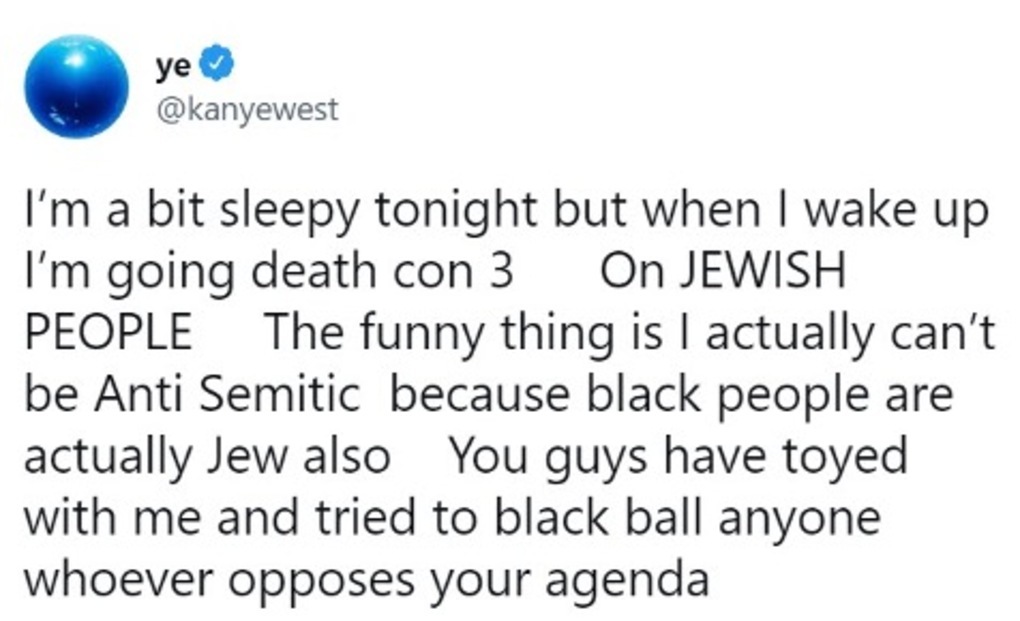
    However, the idea of identifying as Jewish is not just pinpointed to DNA tests; rapper Kanye West claims that his identity as a black man constitutes him as being Jewish. He uses these claims to justify his antisemitic remarks that perpetuate stereotypes, endorse conspiracy theories, and call for violence against Jews. Kanye has a large number of supporters who read and believe what he says online, which fuels antisemitism. If a non-Jewish person believes that Kanye is justified in his remarks, they may feel justified in other antisemitic actions or speech.

    Tweet by Kanye West: "I'm a bit sleepy tonight but when I wake up I'm going death con 3 on Jewish people. The funny thing is I actually can't be antisemitic because black people are actually Jew also. You guys have toyed with me and tried to black ball anyone whoever opposes your agenda."

    Judaism is practiced worldwide, and it doesn’t discriminate against a person’s skin color. However, this claim, along with his hate speech, invalidates those of us who actively practice the religion. As a white woman, I don’t want to invalidate Kanye’s identity as a black man. However, I can’t excuse him using his identity to invalidate my own as a Jewish woman.

    Invalidating a religion doesn’t stop with false self-identification. There has been a theme with people who disagree with government policies and relate them to the Holocaust. Although these people may feel unjustly treated for not agreeing or abiding by these policies, they do not compare to the mass extermination of a group of people.

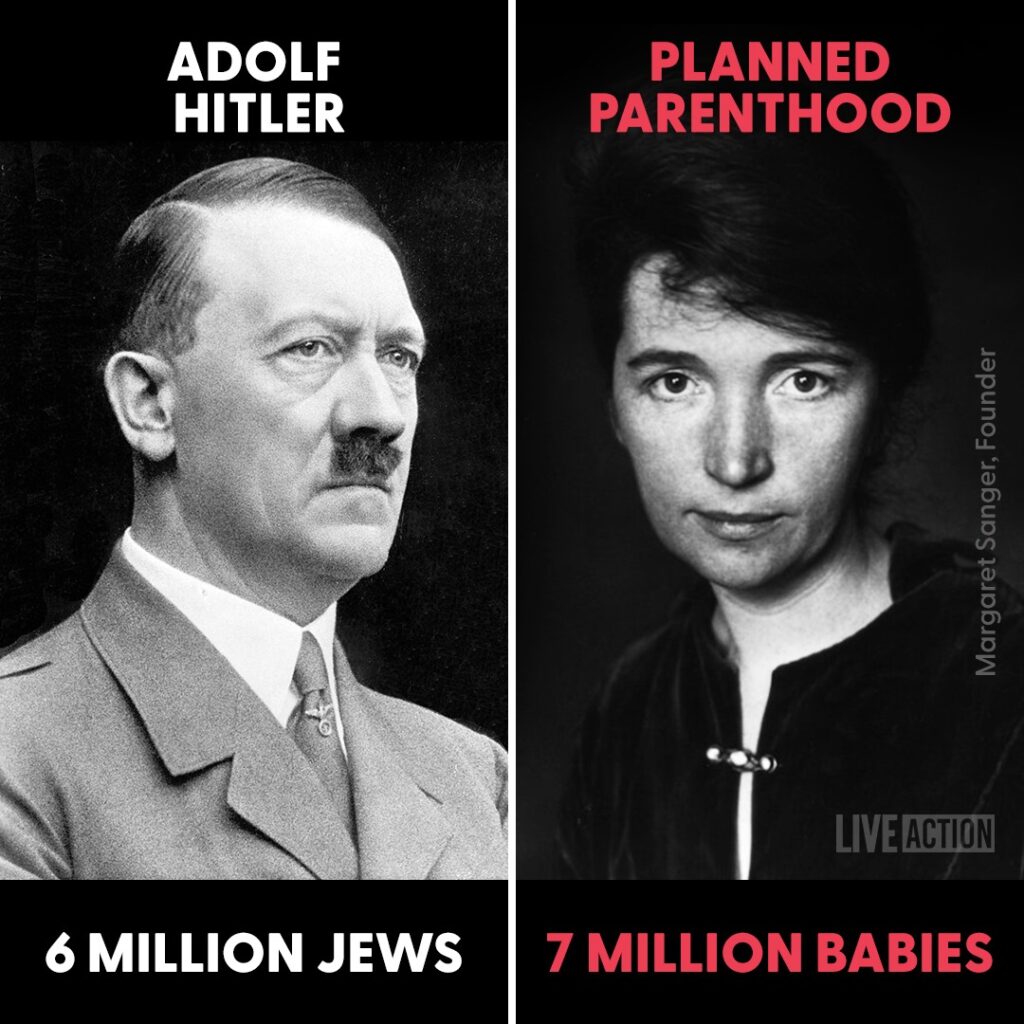
    The topic of abortions has always been, and will always be, controversial; however, with the overturn of Roe v. Wade, people took to social media to defend their stance at any opportunity they could, including relating abortion to the Holocaust. Politicians such as Rep. Mike Johnson, Sen. Darren Bailey, Sen. Ben Albritton, and Rep. Terri Collins have all publicly made this comparison. Pro-life groups online share instigating posts of the same nature; Live Action shared a photo comparing Hitler to Margaret Sanger (founder of Planned Parenthood), comparing the deaths of the Holocaust with abortions. These kinds of posts spread like wildfire on social media; they not only dismiss the tragedies that occurred during the Holocaust but any other act of genocide in history.

    Photo of Adolph Hitler, with additional text saying "6 million Jews" next to a photo of Margaret Sanger saying "7 million babies"

    The difficulty with this is that people who identify as pro-life believe that abortion is equivalent to murder. This is why many laws were placed in effect to convict people associating, performing, and receiving abortions. Although I disagree, I understand why they believe what they do. Despite using the tragedies of the Holocaust to fuel their narrative, there is also an issue of the pro-life stance along with Judaism. Jewish law believes that life begins at first breath, and with this, abortion is considered health care and is encouraged if it endangers the mother’s health physically or mentally. Therefore, the comparison between the Holocaust and abortions not only bastardizes the genocide of Jewish people but uses it to push Catholic beliefs on Jewish people.

  • Book Bans

    Book bans are a way to censor information that doesn’t fit into a certain narrative or rhetoric. According to National Geographic, the earliest book bans in the United States took place in 1650, when the Massachusetts Bay colonist William Pynchon published a religious pamphlet that differed from the religious norms at the time. Other colonists denounced his writing as heresy and burned them. Later on in the US there were bans on literature that was anti-slavery or anything that was deemed “immoral.”

    Today, we see the controversy surrounding reading material in schools and public libraries. The American Library Association noted the top three reasons for book censorship is due to literature containing “sexually explicit” content, “offensive language,” and/or the content is “unsuited for any age group.” Although a CBS poll shows that most Americans reject book bans, PEN America says that most bans are done through smaller organized political groups such as Moms for Liberty.

    Most books that are being targeted are written or about minority experiences. According to PEN America’s Index of School Book Ban List, 41% address LGBTQIA+ themes, 40% contain POC protagonists or prominent secondary characters, 22% contain sexual content (ranging from puberty to sexual abuse), and 9% are nonfictional books (biographies, autobiographies, and memoirs)

    There is no standard for what is deemed inappropriate for readers, and the rhetoric used to push bans causes hysteria within a community. For instance, in Marion County, Mississippi, the graphic novel series Heartstopper by Alice Oseman was being challenged. The books contain a wholesome romance story between two teenage boys, yet they’re being described as “pornography” and that homosexuality is a sin according to the Bible. This rhetoric not only villainizes literature, but also the authors and characters of these books.

    The issue of book banning is still an ongoing problem, and with the pressure of the upcoming election and the threat of Project 2025, this issue is nowhere near being settled. Unfortunately, there will always be people who are trying to censor certain demographics and narratives. However, many libraries and bookstores celebrate Banned Book Week (September 22-28, 2024) in order to raise awareness and encourage reads to read titles they may have otherwise not considered.

  • Three ways to protect yourself online

    As we’ve grown up alongside the internet, we’ve been repeatedly cautioned about the permanence of our online posts. However, the need for vigilance extends beyond this. It’s crucial to be mindful of our internet usage and the potential risks associated with it.

    Our internet usage is constantly being monitored, and our data is tracked. Who or what may not be interested in you as a person, but they are interested in ways they can benefit from your data. When we share our data with one site, we cannot control where they then share our data. Without knowing what these third-party companies are doing with our data, we must protect ourselves and our data from them. There are also people who are interested in obtaining your personal information to commit credit card or identity theft. These things can be detrimental to our individual lives or to the lives of others. Here are some ways we can better protect ourselves:

    1. VPN
    2. Multi-factor Identification
      • Using multi-factor identification when logging into personal accounts online adds an extra layer of protection from potential hackers. Multi-factor identification can range from sending codes to your phone or email to using separate programs. These extra steps may be annoying, but they can greatly reduce your risk of being hacked.
    3. Encryption
      • Encrypting your devices is another layer of protection, similar to multi-factor identification, that prevents your personal information on your devices from being accessed without first entering a password. This means that if you lose your phone or laptop, someone will not be able to access your personal files without entering whatever password you have set. You can encrypt your personal computers and smartphones.

  • Media Diary – September 7

    In my media literacy class, we’ve been learning about our privacy online and how easily it is for others to take personal data to benefit themselves. For today’s 24-hour media diary, i will still share the media I consumed or took part in, yet I’m going to be more mindful about the information I choose to share online.

    I’m not someone who minds my data being used for targeted ads. However, I am very uncomfortable with my data being used by third-party companies in ways that could potentially harm others.

    7-9 am — I woke up to my phone battery being dead! Kind of a bummer, but I used this as an opportunity to get some schoolwork done. I checked what readings I needed to work on before getting started. I read a short story and it took me quite a while because I was annotating. I frequently referenced the Merriam-Webster Online Dictionary to look up words I was unfamiliar with, as well as googling a few things that piqued my interested.

    10-12 pm — After my phone was sufficiently charged, I went for a walk and finished listening to my audiobook. Although I was disappointed in the ending, I enjoyed the overall story and my walk! And, of course, I had to update my Goodreads after finishing the story.

    It’s weird to think about how Amazon is very in tune with my reading habits. Amazon owns Goodreads, so they know what books I’ve read or marked that I’m interested in and what books my friends are reading. I read a lot of books on my Kindle or using audiobooks, and even if they aren’t from Amazon themselves, I still download them to my Kindle, which is connected to my Amazon account. Yet, they still recommend terrible books!

    1-3 pm — I watched a movie for one of my classes while working on my crochet project. It wasn’t something I typically would watch, but I enjoyed it nonetheless!

    6-8 pm — My fiance and I travelled to an event for the evening. As the passenger, I got to be the DJ and navigation! I played various playlists from Spotify throughout the drive. Although we made good timing on our drive there, parking was a nightmare! I constantly looked at Google Maps to see where we were. Once we found a spot, we learned the parking meters were no longer operational. I had to download an app and input my personal information (name, address, license plate number, etc.). AND we had to upload $25 into the app to pay for the $2 parking! Outrageous! All I could think after that, was how whoever has our data from this app, can now see where we came from and where we’re going and for how long we stayed.

    It’s silly to think so much about this parking app when I used Google Maps to get directions, and they are undoubtedly doing the same thing. Yet it feels more personal when it’s done by a major city. What will this local government do with my data? How are they going to analyze it, and what effects will it have?

    8-11 pm — I was pretty much off of my phone during the event, however I did use it a few times to upload to Instagram.

    11-11:30 pm — On our way home, I again used Google Maps to direct us. It didn’t need to use it for the entire drive. We were both pretty tired and had a nice conversation for our ride home.